
Abraham stands as a towering figure in religious history, his actions impacting religions and generations. His story, recorded in the Bible, offers insight into faith, obedience, and the divine-human relationship.
From leaving his homeland to facing unimaginable tests of faith, Abraham’s journey encapsulates the essence of belief and devotion. In this article, we will review into the pivotal moments of Abraham’s life, exploring the significance of his actions and their enduring impact on religious thought and practice.
Who was Abraham in the Bible?
Abraham, a central figure in the Bible, is revered as the patriarch of Judaism, Christianity, and Islam. His narrative unfolds primarily in the book of Genesis, where he is initially known as Abram, residing in Ur of the Chaldeans. God’s call prompts Abram to embark on a transformative journey, leaving behind his homeland and venturing toward a promised land.
Abram’s obedience to this divine directive earns him the name Abraham, symbolizing his destiny as the “father of many nations.” Throughout his life, Abraham’s unwavering faith and obedience serve as a cornerstone for the faith of millions, showcasing the profound impact of belief in the divine.
What Did Abraham Do in the Bible?
Abraham’s story in the Bible is rich with significant events and actions that shape his character and the course of history according to religious traditions. Here are some key highlights of what Abraham did in the Bible:
#1. Leaving his homeland
Genesis 12:1-4 recounts Abraham’s pivotal moment of leaving his homeland:
“The Lord had said to Abram, ‘Go from your country, your people and your father’s household to the land I will show you. I will make you into a great nation, and I will bless you; I will make your name great, and you will be a blessing. I will bless those who bless you, and whoever curses you I will curse; and all peoples on earth will be blessed through you.’ So Abram went, as the Lord had told him…”
Abraham’s obedience to leave his homeland demonstrates his trust and faith in God’s promises. It marks the beginning of God’s covenant with Abraham, setting the stage for the fulfillment of God’s plan for him.
#2. Covenant with God
Abraham enters into a covenant with God, a solemn agreement that marks a significant turning point in his life. Genesis 15:5-6 records:
“He took him outside and said, ‘Look up at the sky and count the stars—if indeed you can count them.’ Then he said to him, ‘So shall your offspring be.’ Abram believed the Lord, and he credited it to him as righteousness.”
This covenant underscores Abraham’s faith in God’s promises, as he believes in the fulfillment of God’s pledge to make his descendants as numerous as the stars.
#3. Birth of Isaac
The birth of Isaac is a momentous event in Abraham’s life, fulfilling God’s promise of descendants. Genesis 21:1-3 narrates:
“Now the Lord was gracious to Sarah as he had said, and the Lord did for Sarah what he had promised. Sarah became pregnant and bore a son to Abraham in his old age, at the very time God had promised him. Abraham gave the name Isaac to the son Sarah bore him.”
Isaac’s birth validates God’s faithfulness to His promises, demonstrating that nothing is impossible with God, even in old age.
#4. Hospitality
Abraham exemplifies hospitality in Genesis 18:1-8 when he welcomes three visitors, who turn out to be angels, into his home:
“Abraham looked up and saw three men standing nearby. When he saw them, he hurried from the entrance of his tent to meet them and bowed low to the ground… ‘Let me get you something to eat, so you can be refreshed and then go on your way—now that you have come to your servant.’ ‘Very well,’ they answered, ‘do as you say.'”
Abraham’s hospitality reflects the value of kindness and generosity, setting an example for believers to extend hospitality to others, even to strangers.
#5. Intercession for Sodom
Abraham intercedes with God on behalf of the city of Sodom in Genesis 18:22-33, displaying compassion and pleading for mercy:
“Then Abraham approached him and said: ‘Will you sweep away the righteous with the wicked?’… ‘Far be it from you to do such a thing—to kill the righteous with the wicked, treating the righteous and the wicked alike. Far be it from you! Will not the Judge of all the earth do right?'”
Abraham’s intercession reveals his concern for justice and mercy, as he appeals to God’s righteousness in sparing the righteous within Sodom.
#6. Test of faith with Isaac
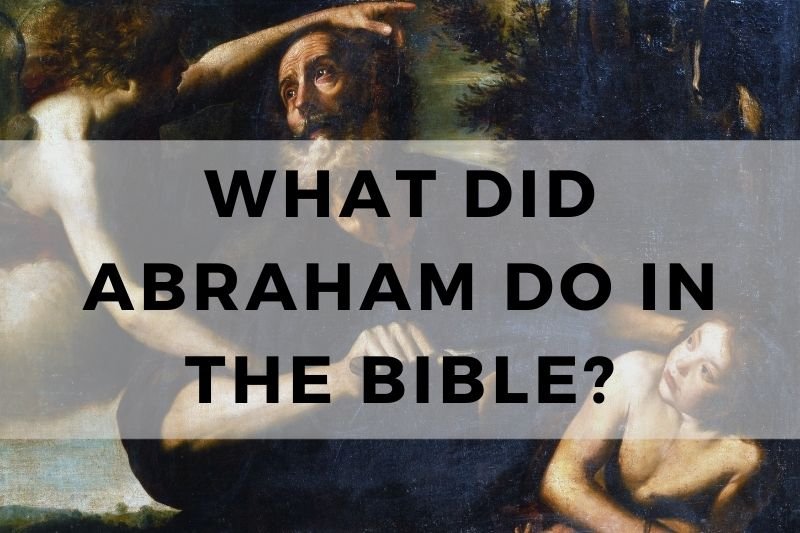
Abraham’s ultimate test of faith comes when God commands him to sacrifice his son Isaac in Genesis 22:1-14:
“Then God said, ‘Take your son, your only son, whom you love—Isaac—and go to the region of Moriah. Sacrifice him there as a burnt offering on a mountain I will show you.’ Early the next morning Abraham got up and loaded his donkey. He took with him two of his servants and his son Isaac… ‘Here I am,’ he replied. ‘Do not lay a hand on the boy,’ he said. ‘Do not do anything to him. Now I know that you fear God, because you have not withheld from me your son, your only son.'”
Abraham’s willingness to obey God, even in the most difficult and heart-wrenching circumstances, illustrates the depth of his faith and devotion. It serves as a profound example of surrendering to God’s will, even when it seems incomprehensible.
Closing Thoughts
Abraham’s journey in the Bible serves as a testament to faith, obedience, and the enduring relationship between humanity and the divine. His willingness to trust in God’s promises, even in the face of uncertainty and hardship, inspires believers across generations.
Through his actions, Abraham exemplifies the essence of devotion and the profound impact of aligning one’s life with divine will. His story continues to resonate, reminding us of the transformative power of faith and the unwavering faithfulness of God. As we reflect on Abraham’s life, may we find strength and inspiration in his example of steadfast trust and obedience.